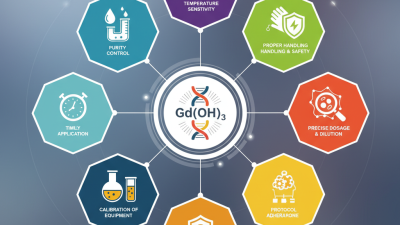
Gadolinium Hydroxide is gaining traction in various industries due to its unique properties and applications. According to a recent report by MarketsandMarkets, the global market for Gadolinium compounds is expected to grow at a CAGR of 5.8% from 2022 to 2027. This growth highlights the increasing demand for Gadolinium Hydroxide in sectors such as electronics, healthcare, and nuclear energy.
Dr. Emily Carter, a noted expert in rare earth materials, emphasizes its significance: "Gadolinium Hydroxide plays a crucial role in advancing modern technology." Its applications range from enhancing magnetic resonance imaging (MRI) agents to serving as a key component in phosphors for LED lights. However, ongoing research is necessary to address environmental concerns associated with its production.
While Gadolinium Hydroxide shows promise, it’s essential to approach its use with caution. There are challenges related to sourcing and refining. Buyers must ensure they select reliable suppliers who prioritize sustainable practices. Understanding this multifaceted compound can lead to innovative solutions while mindful of ecological impacts.

Gadolinium hydroxide is gaining attention in the electronics and semiconductor industries. It serves as an important precursor for various high-tech applications. This compound plays a key role in the production of phosphors used in LED technology. The global LED market is expected to reach $136 billion by 2025, highlighting the growing need for materials like gadolinium hydroxide.
Another crucial application is in the manufacturing of magnetic materials. Gadolinium compounds are essential in developing high-performance magnets used in electric motors and generators. According to a recent report, the global magnet market is projected to grow at a CAGR of 6.6% until 2027. This growth directly impacts the demand for gadolinium-based materials.
Challenges remain in the production process. The synthesis of gadolinium hydroxide faces issues with yield and quality consistency. Ensuring purity and minimizing contaminants can be complex. Quality control measures are vital for successful applications. These obstacles, however, present opportunities for innovation and improvement in production techniques. Exploring these areas can lead to more efficient use of gadolinium hydroxide in the industry.
| Use Case | Description | Industry | Benefits |
|---|---|---|---|
| Display Technology | Used in the fabrication of phosphors for LCD and LED displays. | Electronics | Enhances brightness and color accuracy. |
| Magnetic Resonance Imaging (MRI) | Used as a contrast agent in MRI scans for enhanced image quality. | Medical | Improves diagnosis accuracy. |
| Nuclear Medicine | Utilized in targeted radiotherapy and imaging. | Healthcare | Promotes effective cancer treatments. |
| Data Storage | Employed in the production of high-density magnetic storage devices. | Information Technology | Increases storage capacity and data retrieval speed. |
| Lighting | Integrated into LED lights for superior performance. | Lighting Industry | Enhances energy efficiency and color rendering. |
| Ceramics | Used to manufacture advanced ceramic materials. | Materials Science | Improves thermal stability and mechanical strength. |
| Electronics Cooling | Used in thermoelectric materials for efficient heat management. | Electronics | Enhances device longevity and performance. |
| Research | Utilized in various research applications in physics and chemistry. | Academia | Facilitates advanced studies and innovations. |
| Pharmaceuticals | Involved in drug formulation and development. | Pharmaceutical Industry | Enhances drug efficacy and stability. |
| Catalysts | Applied in catalytic processes for chemical manufacturing. | Chemicals | Improves reaction rates and efficiency. |

Gadolinium hydroxide plays a pivotal role in nuclear medicine and imaging. Its primary application is in MRI contrast agents, enhancing image quality and accuracy. This compound increases the signal strength and improves the visualization of soft tissues. According to industry reports, the global MRI contrast agents market is projected to exceed $5 billion by 2025, driven by rising diagnostic imaging demand.
In nuclear medicine, gadolinium hydroxide is also used for radiopharmaceuticals. These substances assist in diagnosing and treating diseases. With advancements in technology, patient safety and efficacy are at the forefront. However, concerns about gadolinium retention in tissues raise questions about long-term impacts and necessary precautions.
There is a growing focus on reducing side effects while maintaining effective imaging performance. This underscores the need for research and guidelines in dosage and administration. The juxtaposition of effectiveness and safety requires critical reflection in the ongoing development of gadolinium-based products.
Gadolinium hydroxide plays a significant role in magnetic resonance imaging (MRI). This compound is used as a contrast agent due to its paramagnetic properties. These properties enhance the visibility of internal structures in MRI scans. When injected into the body, gadolinium ions help to create clearer images. This clarity is crucial for accurate diagnosis.
However, the use of gadolinium in MRI is not without concerns. Some patients experience adverse reactions. These can range from mild allergic responses to more severe complications. Consequently, it's vital for healthcare professionals to assess the risks and benefits carefully. Quality control in the production of gadolinium-based contrast agents is essential. Variability in the manufacturing process can lead to inconsistencies in safety and efficacy.
Emerging studies are examining alternative contrast agents. These alternatives aim to reduce the risk of adverse reactions while maintaining imaging clarity. The ongoing evaluation of gadolinium’s role in MRI highlights the need for continued research. Understanding the balance between utility and safety is fundamental to advancing medical imaging technology.
Gadolinium hydroxide is gaining attention as an effective catalyst in various chemical reactions. Its unique properties enhance reaction rates and improve yields. This compound acts by providing a stable environment for reactants to interact. When used judiciously, gadolinium hydroxide can drive reactions towards favorable products.
In organic synthesis, gadolinium hydroxide facilitates the formation of complex structures. Researchers have found that using this catalyst can reduce the energy barrier for certain reactions. Yet, the consistency in results can vary. Each reaction's specific conditions might impact the efficiency of the catalyst. It is essential to conduct thorough trials to optimize the use of gadolinium hydroxide.
While the advantages of gadolinium hydroxide are evident, there are challenges. Its solubility can affect its effectiveness in some media. Users must carefully consider the reaction environment. Even small changes can lead to different outcomes. This unpredictability requires careful planning and testing. Experimentation is key to realizing its full potential in chemical processes.
Gadolinium hydroxide plays a vital role in advanced materials production. This compound is increasingly valued for its unique properties, particularly in the fields of electronics and photonics. According to a recent report by ResearchAndMarkets, the demand for gadolinium-based materials is projected to grow by 7.5% annually through 2030. This growth favors the integration of gadolinium hydroxide into high-performance magnets and phosphors, underscoring its significance.
In electronics, gadolinium hydroxide enhances dielectric materials, improving energy efficiency and signal integrity. Its ability to serve as a neutron absorber makes it essential in nuclear technologies and radiation shielding. The versatility of gadolinium hydroxide extends to catalysts used in chemical reactions. However, challenges remain, such as its processing cost and scarcity, which may hinder widespread adoption.
Consider optimizing your supply chain if sourcing gadolinium hydroxide. Research on local availability and market trends can provide you with cost-effective options. Engaging with industry experts will also help you navigate the complexities of implementing this material in your production processes. Remember, understanding the nuances of gadolinium hydroxide can lead to innovative solutions in your projects. Keep an eye on market disruptions that could affect supply and demand.