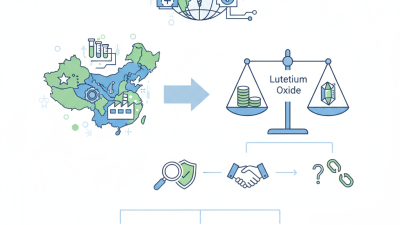
In 2026, global buyers will evaluate Lutetium Oxide suppliers beyond headline pricing. Purity, traceability, packaging, and technical support will matter equally.
Lutetium Oxide is a specialized rare-earth material. Its value depends on consistent composition and dependable documentation. Buyers may require 99.9% or higher purity, depending on their application. Each lot should include a certificate of analysis, batch number, and test method. ICP-MS data can help verify trace impurities. Particle size also deserves attention. Fine powder may improve processing, but it can create handling challenges.
Details matter.
Dr. Jack Lifton, a respected rare-earths industry consultant, often emphasized, “Rare earths are not rare; they are difficult to extract.” This principle remains useful for supplier evaluation. Mining, separation, refining, and export logistics can influence delivery reliability. A polished website cannot prove production capability. A sealed container, clear labeling, and stable lot history provide stronger evidence.
This guide examines the 2026 best Lutetium Oxide suppliers for global buyers. It considers manufacturing experience, quality systems, production capacity, lead times, and responsive communication. It also reviews whether suppliers explain origin and compliance documentation clearly. Responsible buyers should confirm current requirements in their own countries. Standards and import rules can change.
The market is not perfectly transparent. Some supplier claims need closer questioning. A lower quote may hide longer lead times or weaker testing. Practical evaluation should include samples, reference checks, written specifications, and realistic delivery terms. No supplier fits every buyer. The strongest choice is the one that matches technical needs with verifiable reliability.

Lutetium oxide, or Lu2O3, is a dense, white rare-earth powder containing element 71. Its value comes from demanding applications, including scintillation materials, specialized ceramics, catalysts, and research involving lutetium isotopes. The US Geological Survey reported about 350,000 metric tons of global rare-earth mine production in 2023, measured as rare-earth-oxide equivalent. That figure covers many elements, not lutetium alone. Lutetium remains a small, strategically sensitive fraction of the wider rare-earth supply chain.
Supplier selection therefore requires more than comparing prices. Buyers should request batch-specific certificates showing lutetium content, major impurities, moisture, particle size, and analytical methods. ICP-MS, X-ray diffraction, and loss-on-ignition data can reveal differences hidden by a simple purity label. Packaging also matters. A sealed double bag inside a rigid drum helps protect the powder from moisture and contamination during long-distance transport. The USGS Mineral Commodity Summaries 2024 notes that rare-earth supply is concentrated across limited producing regions, which increases exposure to refining delays, export controls, and inconsistent lead times.
Ask practical questions. Can the supplier provide three consecutive lot records? Is the material traceable to a production batch? Are safety data and transport documents current? A low quoted price may reflect weaker testing or uncertain availability. Even experienced buyers can overestimate purity consistency. That assumption deserves testing. Supplier audits, retained samples, and an agreed incoming inspection plan provide stronger protection than a polished catalogue description.

2026 Best Lutetium Oxide Suppliers for Global Buyers
How to Evaluate Lutetium Oxide Quality, Purity, and Specifications
For global buyers, evaluating lutetium oxide starts with its intended use, not a supplier ranking. Lu2O3 may support optical ceramics, specialty glass, research, or advanced electronic materials. Each application can require different limits for purity, particle size, and moisture. Request the exact grade, chemical formula, CAS number, and stated rare-earth oxide basis. Small details matter. Ask why.
Purity claims require supporting evidence. A reliable certificate of analysis should identify the production lot, test date, methods, and measured results. ICP-OES or ICP-MS can help verify metallic impurities, while XRD can confirm crystal structure and unwanted phases. Check loss on ignition, chloride, sulfate, iron, calcium, and other trace elements. Particle-size data should state the measurement method. Laser diffraction and microscopy may produce different results. Do not treat one number as universal.
Packaging also affects quality during international transport. Moisture-resistant double bags, sealed drums, and clear storage instructions reduce contamination risks. Request a representative sample before approving a large order. Compare its color, flowability, assay, and particle distribution with the COA. I have found that supplier questions often reveal more than polished documents. Perfect data is rare. Review any unusual variation rather than ignoring it. A practical audit should also examine batch consistency, document control, technical support, and the supplier’s ability to explain deviations clearly.
| Evaluation Dimension | Verified Technical Reference or Target | Why It Matters to Global Buyers | Recommended Evidence to Request |
|---|---|---|---|
| Chemical identity | Lutetium(III) oxide; formula Lu2O3; CAS RN 12003-86-0; molecular weight approximately 397.93 g/mol | Confirms that the offered material is the required oxide rather than another lutetium compound or a blended rare-earth material. | Certificate of analysis, product specification, safety data sheet, and lot identification. |
| Total rare-earth oxide purity | Common high-purity purchasing targets are ≥99.9%, ≥99.99%, or ≥99.999% on an oxide basis. The exact grade must be stated in the purchase specification. | Higher purity reduces the risk that foreign rare-earth elements will affect optical, ceramic, catalytic, or research performance. | Lot-specific assay result, analytical method, detection limits, and clear definition of “purity.” |
| Individual rare-earth impurities | Set maximum limits for neighboring and common rare-earth elements, including Y, La, Ce, Pr, Nd, Sm, Eu, Gd, Tb, Dy, Ho, Er, Tm, Yb, and other Lu-related impurities. | A high total purity value can conceal one impurity that is unacceptable for a specific application. | ICP-MS, ICP-OES, or validated equivalent results reported for each relevant element, not only a combined total. |
| Non-rare-earth metallic impurities | Control elements such as Fe, Ni, Cr, Cu, Mn, Zn, Ca, Mg, Na, K, Al, Si, Pb, and other process-related contaminants according to application needs. | Trace metals can influence color, conductivity, sintering behavior, dielectric properties, and long-term stability. | Element-by-element impurity table with units, limits, actual results, and method detection limits. |
| Loss on ignition and volatile matter | Define a maximum loss-on-ignition or volatile-content value appropriate to the application; do not accept an unspecified “dry basis.” | Adsorbed water, carbonates, residual solvents, or processing aids can change powder handling and final firing results. | Test temperature, holding time, sample condition, basis of calculation, and batch result. |
| Moisture and hygroscopic behavior | Specify maximum moisture and packaging conditions; confirm whether results are reported as received or after drying. | Moisture can cause agglomeration, inconsistent weighing, and variation during slurry or powder processing. | Moisture test result, sampling procedure, sealed packaging description, and storage recommendation. |
| Crystal phase and structure | Lu2O3 is commonly supplied as a cubic rare-earth sesquioxide. Phase confirmation should be performed by X-ray diffraction. | Unwanted phases or amorphous content may affect densification, optical behavior, and reproducibility. | XRD pattern, reference database or phase assignment, crystallinity information, and batch traceability. |
| Particle-size distribution | Require D10, D50, and D90 values or a defined mesh range. The correct target depends on pressing, coating, polishing, or sintering requirements. | Particle size affects flowability, packing density, reaction rate, surface area, and final ceramic microstructure. | Laser diffraction or another stated method, dispersion conditions, and representative particle-size chart. |
| Specific surface area | Request a BET surface-area range when reactivity, catalysis, coating, or fine-grained sintering is important. | Surface area provides information that particle-size data alone may not capture, particularly for porous or agglomerated powders. | BET method, degassing conditions, sample mass, and lot-specific result. |
| Morphology and agglomeration | Define acceptable morphology, hard-agglomerate level, and powder flow requirements for the intended process. | Agglomerates can produce defects, uneven packing, poor dispersion, and inconsistent sintering. | SEM images at stated magnification, dispersion test, tap density, and flowability data when relevant. |
| Thermal properties | Reference data commonly report a melting point near 2,400–2,500 °C for lutetium oxide; use supplier test data only when the measurement method is documented. | Thermal stability is important for high-temperature ceramics, crucibles, coatings, and material-processing decisions. | Thermal analysis or validated reference data, test atmosphere, calibration details, and uncertainty. |
| Bulk density and packing behavior | Specify apparent density or tap density only when relevant, because values depend strongly on particle size, moisture, and measurement procedure. | Supports accurate filling, transportation planning, blending, and powder-compaction control. | Test standard or internal method, conditioning procedure, and lot-specific measurement. |
| Packaging and contamination control | Use sealed, moisture-resistant inner packaging with clean outer protection; define net weight, lot number, tamper evidence, and storage conditions. | Proper packaging limits moisture uptake, cross-contamination, loss of traceability, and transit damage. | Packaging specification, photographs or inspection records, label template, and shelf-life or storage statement. |
| Quality-management controls | Prefer documented batch control, calibrated instruments, retained samples, deviation handling, and change-notification procedures. | These controls improve consistency between shipments and make nonconformance investigations possible. | Quality certificate, audit questionnaire, calibration records, sample-retention policy, and change-control procedure. |
| Regulatory and transport documentation | Confirm current SDS, classification, customs information, country-of-origin documentation, export controls where applicable, and destination-market requirements. | Accurate documentation reduces customs delays, workplace-safety risks, and import-compliance problems. | Current SDS, commercial invoice data, packing list, certificate of origin, and transport classification review. |
| Sampling and acceptance testing | Agree in advance on sampling location, number of containers, composite-sample rules, retest procedure, and acceptance criteria. | A clear protocol prevents disputes caused by non-representative samples or different analytical bases. | Approved inspection plan, independent laboratory option, retain-sample process, and nonconformance workflow. |
Where to Find Reliable Lutetium Oxide Suppliers in 2026
Global buyers can locate reliable lutetium oxide suppliers through established chemical distributors, specialty inorganic material producers, and verified scientific procurement platforms. Regional trade directories can help, but listings alone prove little. A serious supplier should provide a current SDS, technical data sheet, and lot-specific certificate of analysis. Check purity, particle size, moisture, and heavy rare-earth impurities before comparing prices.
In practical sourcing, request a small sample before placing a larger order. Ask whether testing uses ICP-MS, XRD, or another recognized method. Confirm the stated lutetium oxide formula, packaging material, storage conditions, and production date. Sealed containers and clear batch numbers matter. So does traceability. A supplier should explain where the material was produced and how complaints are handled.
Look beyond polished websites. They can mislead. Review audit records, quality certifications, response times, and export documentation. Confirm customs requirements and destination-country chemical rules before shipment. Some suppliers answer quickly but provide vague test data. That is a warning sign. A second review by an independent laboratory may add cost, yet it can protect a high-value purchase. One point deserves reflection: the lowest quotation may hide inconsistent particle size, delayed delivery, or weak technical support. Reliability must be measured across several orders, not one successful sample.
When comparing lutetium oxide suppliers in 2026, buyers should verify product identity, purity, and physical specifications against recognized reference data. The chart below summarizes key reference properties of lutetium oxide (Lu₂O₃), which can support technical screening and supplier specification checks.
Reference note: Lutetium oxide has the chemical formula Lu₂O₃, CAS number 12032-20-1, a molar mass of approximately 397.93 g/mol, a density of about 9.42 g/cm³, and a melting point near 2,490°C. Actual commercial specifications may vary by grade, particle size, purity, packaging, and intended application.
For global buyers, the “best” lutetium oxide supplier depends on delivered cost, not the lowest quoted price. USGS Mineral Commodity Summaries 2025 reported global rare-earth mine production at about 390,000 metric tons of rare-earth-oxide equivalent in 2024. However, lutetium oxide pricing is rarely published separately. Buyers should request quotes by purity, assay method, particle size, lot weight, and Incoterm. A 99.99% powder in a 100-gram lot will not compare fairly with lower-purity material in kilogram quantities. Ask for a recent certificate of analysis and verify lutetium content, moisture, and trace metallic impurities.
Packaging needs practical inspection. Look for a sealed inner liner, rigid outer protection, tamper evidence, and clear lot identification. For research-grade powder, small containers reduce repeated exposure. Larger industrial lots may lower packaging costs, but they can increase handling risk. UNCTAD’s Review of Maritime Transport 2024 notes that more than 80% of global merchandise trade by volume moves by sea. Sea freight may reduce cost, yet it usually adds longer transit and more transfer points. Air freight suits urgent samples, but its quoted “door-to-door” cost can hide customs handling fees.
Tips: Compare landed cost, not product price. Request three shipping scenarios: air, sea, and consolidated freight. Check whether insurance, export documents, and destination clearance are included. One imperfect habit is trusting a polished quotation too quickly. Reconfirm currency, delivery term, packaging weight, and quote validity before approval. Also, ask how the supplier handles delayed vessels or damaged containers. Forecasts often look cleaner than reality.
Global buyers should treat supplier screening as a technical audit, not a price comparison. The USGS Mineral Commodity Summaries 2025 estimated 2024 global rare-earth mine production at 390,000 metric tons, with China accounting for 270,000 metric tons. However, these figures cover rare earths broadly, not lutetium oxide specifically. Ask for production evidence, batch traceability, and the actual refining location.
Request a current Safety Data Sheet with all 16 GHS sections. Check the product identity, CAS number, purity, particle size, moisture, and limits for metallic impurities. Each lot should include an independent Certificate of Analysis. Compare its test method with ISO, ASTM, or validated laboratory procedures. A certificate alone is not proof. Review REACH duties, import classification, customs documentation, and local chemical inventory requirements before shipment. The ECHA compliance framework places responsibility on companies importing substances into applicable markets.
Control the powder carefully. Use sealed packaging, local exhaust ventilation, eye protection, gloves, and written spill procedures. Natural lutetium contains a small proportion of Lu-176, so buyers should confirm isotope declarations and radiation-screening records when regulations or applications require them. The IAEA’s safety framework supports risk-based monitoring, but ordinary chemical dust controls remain essential. Supplier audits should include worker training, waste handling, emergency contacts, and transport records. Some checks may feel excessive. They are still cheaper than a rejected shipment or an unexplained exposure.