How to Use Lutetium Oxide for Advanced Materials and Applications?
Lutetium Oxide is gaining attention in advanced materials development. This compound offers unique properties such as high thermal stability and excellent optical performance. Reports from leading industry analysts highlight a growing demand for Lutetium Oxide in sectors like electronics and optics. For instance, the global market for rare earth materials, including Lutetium Oxide, is projected to reach $9 billion by 2026.
The utilization of Lutetium Oxide in phosphor applications is noteworthy. These materials enhance efficiency in LED technologies, directly impacting energy consumption. Industry studies reveal that the demand for efficient lighting solutions is on the rise, which could lead to significant growth in Lutetium Oxide applications. Furthermore, as manufacturers increasingly focus on sustainability, Lutetium Oxide's role in creating eco-friendly materials becomes pivotal.
While promising, the use of Lutetium Oxide is not without challenges. Sourcing the raw materials raises questions about supply chain stability. Additionally, the complexity of the synthesis process requires expertise and innovation. Exploring these aspects can foster a better understanding of how to maximize Lutetium Oxide's potential within advanced materials.

Overview of Lutetium Oxide and Its Properties
Lutetium oxide, known for its unique properties, plays a crucial role in advanced materials. This compound exhibits high thermal stability and a brilliant optical quality. Its ability to resist heat makes it ideal for use in various applications, including catalysts and phosphors.
When considering its use, one must pay attention to its properties. Lutetium oxide has a high refractive index. This makes it useful in optical devices and lasers. Additionally, its luminescent qualities enhance the performance of LEDs. However, the source and purity of lutetium oxide can affect its effectiveness. Always verify your source quality.
Tips: When selecting lutetium oxide for projects, evaluate its particle size. Smaller particles often yield better results. Conduct thorough research to understand the specific requirements for your application. A comprehensive analysis can save time and resources.
Applications of Lutetium Oxide in Electronics and Optoelectronics
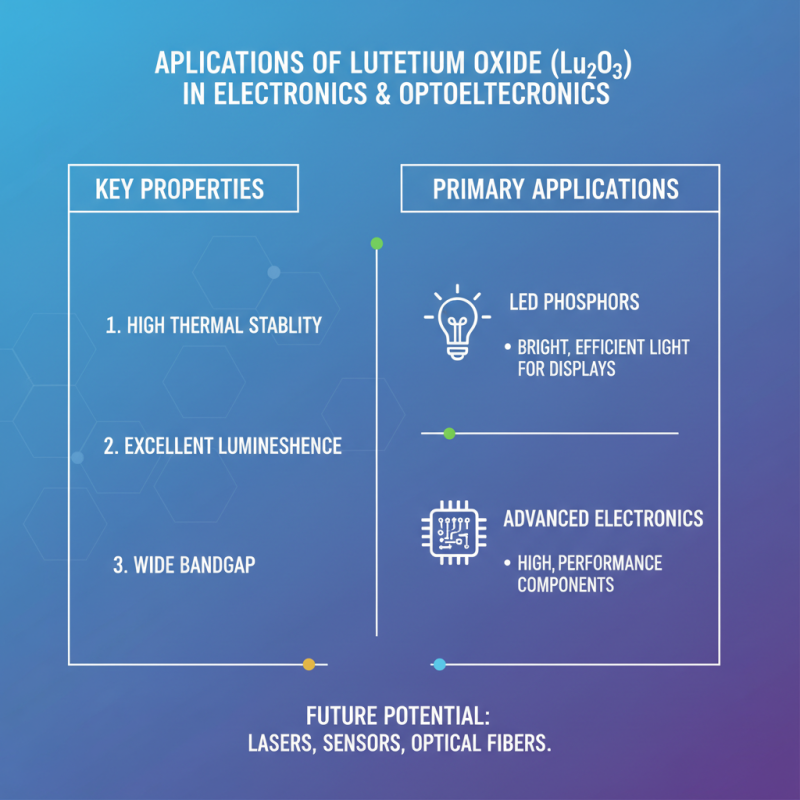
Lutetium oxide (Lu2O3) is gaining traction in electronics and optoelectronics. This compound exhibits remarkable properties that make it useful in various applications. Its high thermal stability and excellent luminescence are noteworthy. For instance, Lutetium oxide is often used in phosphors for LED displays. These displays benefit from the bright and efficient light produced by lutetium-based materials.
In the realm of electronics, Lutetium oxide serves a vital role in semiconductors. It enhances the performance of transistors and diodes. By improving electron mobility, it allows devices to operate at higher speeds. This improvement can lead to smaller and more efficient electronic components. However, the synthesis process of lutetium oxide is not without challenges. Achieving purity and consistency remains a concern. Research is ongoing to refine these processes and enhance reliability.
Optoelectronics also sees the advantages of Lutetium oxide. It is used in laser technology and optical coatings. These applications require precise material characteristics to achieve desired outcomes. Yet, the variability in material quality can affect performance. Continued innovation in this area is essential. Exploring Lutetium oxide's potential will likely yield exciting advancements. Future research may guide its integration into next-generation technologies.
Using Lutetium Oxide in Luminescent and Phosphor Materials
Lutetium oxide is emerging as a key player in luminescent and phosphor materials. Its unique optical properties make it ideal for various applications. Recent studies confirm Lutetium oxide's high photoluminescence efficiency. This efficiency often exceeds 90%, making it highly effective for lighting and display technologies.
In phosphor applications, Lutetium oxide can significantly enhance the brightness of materials. It provides a robust alternative to traditional phosphors. The material can be doped with rare earth ions to tune its emission spectra. This ability enables the creation of versatile luminescent materials tailored for specific needs. Reports suggest that the global phosphor market is projected to reach over $40 billion by 2025, with Lutetium oxide being a driving force.
The implementation of Lutetium oxide in modern technology isn’t without challenges. Its cost remains a consideration for widespread adoption. Sourcing and refining Lutetium can be resource-intensive. Therefore, researchers are exploring sustainable methods to minimize environmental impact. The journey towards optimizing Lutetium oxide in luminescence requires ongoing innovation.
Usage of Lutetium Oxide in Advanced Materials
Synthesis Methods for Advanced Lutetium Oxide Materials
Lutetium oxide (Lu2O3) is gaining traction in advanced materials. Its unique properties make it essential in various applications, including electronics and optics. The synthesis of high-purity lutetium oxide plays a critical role in material performance. Common synthesis methods include sol-gel processes, hydrothermal synthesis, and solid-state reactions. Each method has its advantages and limitations.
The sol-gel process allows for precise control over the chemical composition and microstructure. This technique typically yields a more homogeneous material with enhanced properties. A study noted that sol-gel-derived Lu2O3 exhibits superior photocatalytic activity compared to materials synthesized by traditional methods. Hydrothermal synthesis, on the other hand, offers a favorable environment for forming crystalline structures. However, it often requires high-pressure conditions, which can limit scalability.
Solid-state reactions remain a widely used method due to their simplicity. However, achieving high purity can be a challenge. Variations in temperature and reaction time can lead to impurities that significantly affect the material's performance. Recent data suggests that the purity of lutetium oxide impacts its electronic properties, emphasizing the need for careful synthesis. As the demand for advanced materials increases, refining these synthesis methods will be key to unlocking new applications for lutetium oxide.
Future Trends and Research Directions for Lutetium Oxide Utilization
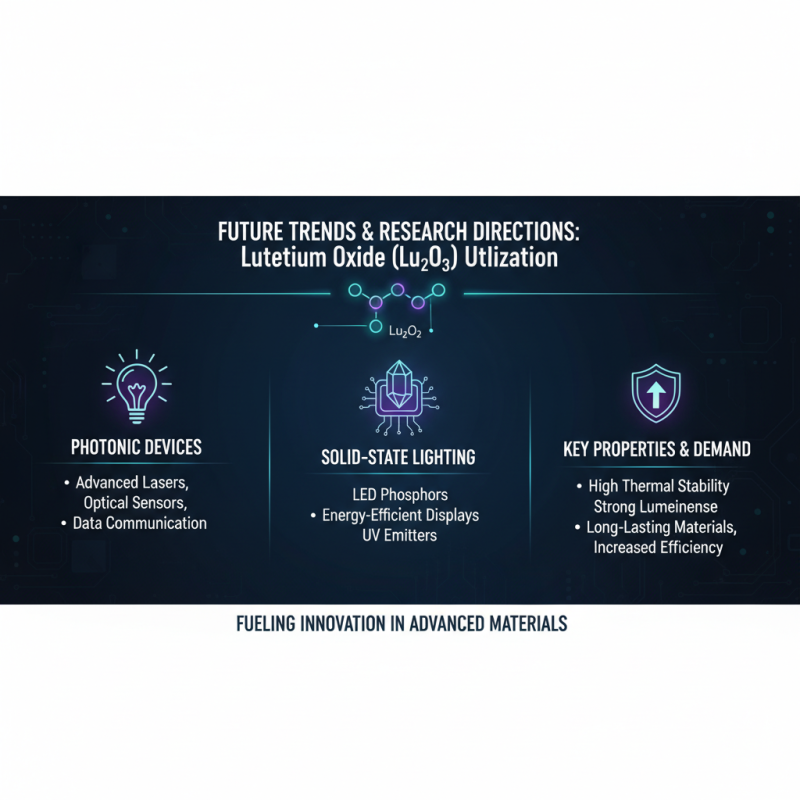
Lutetium oxide (Lu2O3) presents exciting opportunities in advanced materials science. Its unique properties, including high thermal stability and luminescence, make it suitable for various applications. Researchers are now exploring its role in photonic devices and solid-state lighting. The demand for efficient, long-lasting materials is higher than ever.
Future trends indicate that there will be increased focus on Lu2O3 in nanotechnology. Its incorporation into nanoscale materials can improve the efficiency of electronic devices. Additionally, there’s a push for using lutetium oxide in high-performance catalysts. The transition to green technology can benefit from these advancements. Yet, challenges remain. The cost of production and material sourcing requires careful consideration.
Investigation into Lu2O3 also involves interdisciplinary collaboration. Scientists from chemistry, physics, and materials science are working together. This collaboration ignites innovative applications. However, it is crucial to address sustainability and environmental impact. Balancing technological advancement with responsibility will drive future research. Each discovery brings new questions and areas for improvement, ensuring that lutetium oxide remains a focal point in material science.