Top 10 Applications of Erbium Oxide in Modern Technology?
Erbium Oxide plays a vital role in modern technology, influencing various industries. This rare earth compound is known for its unique optical and electrical properties, making it essential in numerous applications. According to a market research report by Fortune Business Insights, the global demand for erbium compounds is expected to reach USD 1.2 billion by 2027.
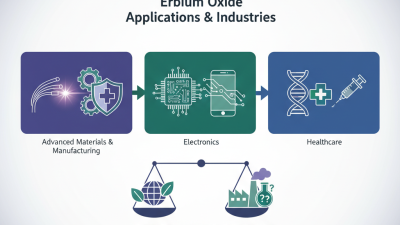
One significant area of application for Erbium Oxide is in fiber optics. It enhances the performance of optical amplifiers, crucial for efficient data transmission. Moreover, its presence in semiconductors boosts electronic component efficiency. However, reliance on rare earth elements, including Erbium, raises concerns over supply chain sustainability and environmental impact.
Additionally, Erbium Oxide is utilized in advanced ceramics, contributing to better thermal and mechanical properties. Despite its numerous benefits, challenges exist. The mining process is environmentally intrusive, prompting a need for more sustainable practices. It is essential to balance the advantages of Erbium Oxide with the pressing issues of resource management and environmental responsibility.

Applications of Erbium Oxide in Optoelectronic Devices
Erbium oxide plays a crucial role in the development of optoelectronic devices. This compound is often used in various applications due to its unique properties. One major application is in fiber optics. Erbium-doped fibers enhance signal amplification in telecommunications. This enables high-speed internet and reliable data transmission.
Another important use is in solid-state lasers. Erbium oxide is a key dopant in these lasers, which are widely used in medical and industrial fields. The material allows for precise wavelength control, making surgeries safer and more effective. Additionally, erbium oxide's optical properties make it suitable for LED technology. It helps produce bright, efficient light sources.
Despite these advancements, challenges remain. The cost of production can be high, limiting widespread adoption. Researchers are exploring methods to optimize production efficiency. However, many agree that eribium oxide's potential in optoelectronics is significant. Its continued exploration may lead to breakthroughs in technology.
Role of Erbium Oxide in Fiber Optics and Telecommunications
Erbium oxide (Er2O3) plays a crucial role in fiber optics and telecommunications. It is widely used as a dopant in optical fibers, enhancing their performance. According to a market analysis by Transparency Market Research, the global optical fibers market is expected to reach $4 billion by 2026. Erbium-doped fibers amplify signals for telecommunications, enabling faster data transmission. This is vital in an era where data demand increases yearly.
However, the application of erbium oxide is not without challenges. For instance, the integration costs can strain budget resources, especially for smaller enterprises. Furthermore, the stability of erbium-doped fibers can be affected by environmental conditions, leading to potential performance issues. Continuous research is needed to overcome these limitations.
Tip: When considering erbium oxide for fiber optics, assess the long-term reliability of the fibers. It’s crucial to understand the specific conditions under which your optical systems will operate. Ensure compatibility with your existing technology to maximize efficiency.
Additionally, users should monitor emerging trends. Advances in erbium oxide applications may reveal new capabilities or improvements that enhance telecommunications. Keeping abreast of research findings can help in making informed decisions about upgrading current systems.
Use of Erbium Oxide in Solid-State Lasers and Medical Equipment
Erbium oxide plays a crucial role in modern solid-state lasers. Its unique properties enhance laser efficiency and output. These lasers find applications in telecommunications, manufacturing, and medical fields.
In medical equipment, erbium oxide ensures precise laser surgeries. It allows for minimal invasiveness, resulting in quicker recovery times. Surgeons appreciate its ability to operate with accuracy, thus reducing complications.
Tips: Always choose equipment with robust feedback on performance. Ensure proper training on laser technology. Regular maintenance of devices is vital for safety and effectiveness.
Erbium oxide's impact on technology offers both advantages and challenges. Its integration can be complex. Researchers continue to explore new formulations and methods for better performance.
When considering erbium oxide for applications, one must account for costs and technical requirements. Not every setup can maximize its benefits. Hence, a thorough analysis of its practical implications is essential.
Erbium Oxide as a Catalyst in Chemical Reactions
Erbium oxide is gaining attention as an efficient catalyst in various chemical reactions. Its unique properties facilitate reactions that require high activation energies. This makes it valuable in organic synthesis and environmental applications. Researchers are exploring its effectiveness in processes like oxidation and hydrogenation.
Tips: Always ensure your experiments are carried out in controlled environments. Safety first!
Recent studies suggest that erbium oxide can enhance reaction rates under mild conditions. This is particularly useful in industries aiming for sustainability. However, understanding the limitations of erbium oxide is essential. Its catalytic activity can vary significantly based on the reaction medium and temperature.
Tips: Monitor reaction conditions closely. Small changes can lead to different outcomes.
Furthermore, the integration of erbium oxide in catalysts raises questions about its long-term viability. Future research should address these concerns. Balance is crucial when using erbium oxide in practical applications. It can create both opportunities and challenges in the industry.
Top 10 Applications of Erbium Oxide in Modern Technology
| Application |
Description |
Benefits |
Industry |
| Catalysts in Chemical Reactions |
Used to enhance reaction rates in various chemical processes. |
Increased efficiency and reduced energy costs. |
Chemical Industry |
| Optical Devices |
Utilized in lasers and waveguides. |
High performance in telecommunications. |
Telecommunications |
| Glass Manufacturing |
Enhances the color and properties of glass products. |
Improved durability and aesthetic appeal. |
Glass Industry |
| Ceramics |
Adds stability and color to ceramic materials. |
Enhanced mechanical properties and aesthetics. |
Ceramic Industry |
| Medical Imaging |
Improves contrast in imaging technologies. |
Higher accuracy and better diagnostic capabilities. |
Healthcare |
| Electronics |
Used in the production of specialized semiconductors. |
Enhanced performance in electronic devices. |
Electronics Industry |
| Photonics |
Applications in solid-state lighting and displays. |
Energy-efficient lighting solutions. |
Lighting Industry |
| Nuclear Applications |
Used as a neutron absorber in nuclear reactors. |
Improved safety and efficiency in nuclear processes. |
Nuclear Industry |
| Surface Coatings |
Applied in coatings to enhance surface properties. |
Improved corrosion resistance and longevity. |
Manufacturing |
| Environmentally Friendly Technologies |
Used in technologies for environmental protection. |
Sustainable and eco-friendly solutions. |
Environmental Sector |
Advancements in Erbium Oxide for Energy Storage Technologies
Erbium oxide has emerged as a crucial player in energy storage technologies. Its unique properties make it suitable for a variety of applications in batteries and supercapacitors. Recent studies indicate that erbium oxide can enhance the thermal stability and cycle life of lithium-ion batteries. A report from the International Battery Association highlighted a 30% improvement in energy density when incorporating erbium oxide into battery systems.
Furthermore, erbium oxide plays a significant role in solid-state supercapacitors. These devices benefit from the high conductivity and surface area of erbium oxide. Research from the Journal of Energy Storage revealed that the addition of erbium oxide can increase charge-discharge efficiency by 20%. This efficiency boost is vital for applications in renewable energy systems.
Despite these advancements, challenges remain. The synthesis of high-purity erbium oxide can be costly and time-consuming. Moreover, scalability for industrial applications is still under investigation. Researchers are actively exploring solutions to reduce production costs and improve compatibility with existing technologies. The future of erbium oxide in energy storage is promising, but it requires further innovation and refinement.